Sources
The Measure of a “Kezayit” and a “Revi’it”
Regarding the fundamental issue of the measure of a kezayit, those of us from Sephardic communities need not enter between the high mountains—the Chazon Ish and Rabbi Chaim Naeh, of blessed memory, and other later authorities—for we have merited a tradition documented by the pen of the great eagle, our master Rambam, of blessed memory. In his Commentary on the Mishnah (Eduyot 1:2), he writes that a revi’it is 27 dirhams of water; accordingly, a kezayit is nine dirhams. The dirham, a coin used as a weight by Muslim goldsmiths, is still available today and weighs 3.2 grams. Accordingly, a revi’it is 86.4 ml and a kezayit is 28.8 grams, approximately the measure of Rabbi Chaim Naeh, of blessed memory. (Excavations in the Western Wall tunnels also uncovered a gate whose dimensions, based on the measurements in the Mishnah, support Rabbi Chaim Naeh’s view, but this is beyond our scope.)
At the end of 5754, Rabbi Hadar Yehudah Margolin, may he be well, published research based on ancient dirham coins he examined in museums around the world. The dirhams from Rambam’s period weigh from 2.7 grams to slightly under 3 grams, principally 2.83 grams; he also took into account that some material had been consumed by oxidation over such a long period. He published his research in the journal Beit Aharon VeYisrael and in several pamphlets. This research was accepted by Maran Rabbi Ovadia Yosef, of blessed and saintly memory as firmly established truth. Based on it, he ruled in Halichot Olam, vol. I, and Me’or Yisrael—and later in Yabia Omer, vol. IX, and Chazon Ovadia in several places—that a dirham is no more than three grams. Thus, a revi’it is 81 ml, and perhaps even 75 ml, while a kezayit is 27 grams. [Maran Rabbi Ovadia Yosef held that this is the maximum measure established with certainty; challah is separated with a blessing on this basis, and there is no need to be concerned for the Chazon Ish’s view when we possess Rambam’s tradition.]
 However, there is a well-known question: how can one determine the measure according to a dirham, which is a weight, when a kezayit is a volume? Although Rambam used a measure of dirhams regarding a revi’it, this was because he knew that the volume of water weighing 27 dirhams is a revi’it. This does not necessarily apply to bread or matzah, whose composition is unlike that of water. If we assess the volume of bread or matzah, we must determine whether the air holes are included, whether crushed volume is considered, and how finely it is crushed, and so forth.
On the other hand, leading halachic authorities did write that the above measure of dirhams may be used to determine the measure of an egg—and a kezayit—in foods. These include Responsa Beit David of Salonika, Orach Chaim 82; Be’er Mayim Chaim Vital 88; Maran the Chida in Birkei Yosef, Orach Chaim 168:4; the Rishon LeZion Rabbi Raphael Meyuchas, of blessed memory, in Pri HaAdamah, vol. I, folio 36b; Shulchan Gavoha; Batei Kenesset; Chasdei David Pardo on the Tosefta; Hamon Chogeg; Rabbi Chaim Palaggi in Chaim LeRosh, folio 109b; Beit Menuchah; Zachor LeYitzchak; and the Ben Ish Chai, year II, Parashat Shemini, section 1; Parashat Tzav, section 34; and Parashat Pinchas, section 19, as well as many other distinguished authorities. Moreover, Rabbi Petach HaDevir, vol. I, no. 190, records that this was the longstanding custom: venerable Torah scholars would weigh a kezayit of matzah on Pesach night as nine dirhams. The explanation, as Maran Rabbi Ovadia Yosef, of blessed memory, concluded, is that the weight of dough, bread, and matzah is comparable to the weight of water. Although a kezayit is a measure of volume rather than weight, it is assessed by weight in order to obtain clear results without relying on estimation.
[Rabbi Moshe Mordechai Karp, may he be well, in Halachot Chag BeChag, offered an innovative explanation for the Sephardic practice of measuring by weight. He suggested that if measured by volume, far fewer grams would suffice, but the ancient Sephardic custom followed the Chazon Ish; thus, they used nine dirhams as the weight of a kezayit, which has the volume of a kezayit according to the Chazon Ish. However, this does not adequately explain the Sephardic custom concerning a revi’it. Rather, the explanation of Maran Rabbi Ovadia Yosef, of blessed memory, is more compelling.]
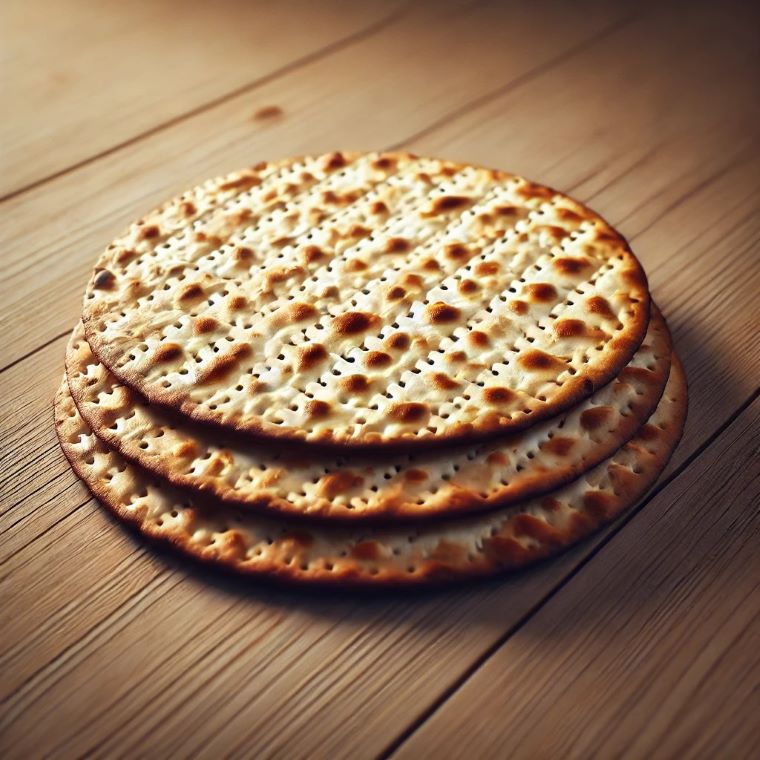
In short, the measure of a kezayit of matzah is 27 grams. This applies to hard matzah. For very heavy soft matzah, our friend Rabbi Yehudah Berachah, may he be well, published his findings that the volume in 38 grams of soft matzah is equal to that in 27 grams of hard matzah. No one has arisen to challenge Rabbi Yehudah Berachah’s ruling, and his view has been accepted by the public. [Accordingly, Rabbi Petach HaDevir and even the Ben Ish Chai must have eaten hard matzah; see further.] Nevertheless, in the Haggadah Yechaveh Da’at by Rabbi David Yosef, may he be well, p. 40, it is written that Maran Rabbi Ovadia Yosef, of blessed memory, would weigh the kezayit of matzah with a mechanical scale on Seder night and distribute 40 to 50 grams to each participant for two kezayit-sized portions, despite eating soft matzah. Likewise, the Haggadah Morashet Maran by Rabbi Ozen, may he be well, p. 108, records testimony from Maran Rabbi Ovadia Yosef’s grandchildren that he was careful to weigh 30 grams for a kezayit, and also states that he ate soft matzah. It is therefore necessary to conclude that Maran Rabbi Ovadia Yosef held there is no difference in this regard, and that approximately 30 grams suffices for a kezayit even with soft matzah, or at most 50 grams for an egg-sized measure.
My esteemed relative by marriage, Rabbi Zamir Cohen, may he be well, elaborated at length on this matter in a special booklet included in his illuminating work, Responsa Nezer Cohen, demonstrating that the true measure is much smaller than all the measures above. He included an approbation from Rabbi Shalom Cohen, may he be well, but he too conceded that, as a stringency, the primary ruling follows the measures above. Therefore, we have only the words of Maran Rabbi Ovadia Yosef, of blessed memory.
Those Who Are Ill and Find It Difficult to Eat a Large Amount
In any event, an ill person who cannot eat much matzah should at least be careful to eat the first kezayit, which is a Torah-level obligation, and should not eat the second kezayit. (If so, however, he should not recite the blessing over washing the hands.) If he cannot eat 27 grams, he may treat 20 grams as a kezayit. If he cannot eat even that, he may rely on Rambam, Rif, and Rosh, who maintain that a kezayit is one-third of an egg, unlike Maran’s ruling in the Shulchan Aruch that it is one-half of an egg. Thus, 18 grams suffice, but he should not recite the blessing “al achilat matzah”; he should recite only “ha-motzi.” Rabbi Meir Mazuz, may he be well, rules that according to Rambam, 15 grams suffice. It is reported in the name of Rabbi Yosef Shalom Elyashiv, of blessed memory, that his halachic opinion was 15 grams even independently of Rambam’s view, since he assessed volume literally. Indeed, according to this approach, perhaps even 9 grams suffice; this has practical relevance for the ill, as above.
Regarding the Requirement of “Kedei Achilat Pras” Mentioned Above
The kezayit must be eaten within the time known as kedei achilat pras. In Shiurei Torah, Rabbi Yaakov Yisrael Kanievsky, the Steipler, of blessed memory, wrote that it is preferable to be stringent for two minutes. Rabbi Chaim Naeh, Kaf HaChaim, Rabbi Shlomo Zalman Auerbach, and others held four minutes; Rabbi Yitzchak Elchanan Spektor, of blessed memory, held five minutes; the Tzemach Tzedek held six minutes; the Bikurei Yaakov and Rabbi Chaim Palaggi held 7.5 minutes; the Sdei Chemed concluded eight minutes; and the Chatam Sofer held nine minutes. However, the primary halachah is that this measure is six to 7.5 minutes, as ruled by Maran Rabbi Ovadia Yosef, of blessed memory, in his final ruling in Chazon Ovadia: Pesach, p. 66. [In Responsa Yechaveh Da’at, vol. I, no. 15, he wrote that regarding matzah it is proper to be stringent for four minutes, but apparently he later revised this view. Nevertheless, Haggadah Yechaveh Da’at by Rabbi David Yosef, may he be well, p. 40, and Rabbi Ozen’s Haggadah testify that although Maran Rabbi Ovadia Yosef instructed the public that kedei achilat pras is 7.5 minutes, on Seder night he asked his household to be stringent and eat within four minutes. See there. Responsa Or LeZion likewise writes that one should preferably be stringent for four minutes, but in pressing circumstances one may rely on six minutes.] Those who are ill and the like, when it is impossible to be stringent, may rely on those who maintain nine minutes, following the Chatam Sofer, as the Chazon Ish also favored. If there is no alternative at all, one should know that Responsa Machaneh Chaim maintains that kedei achilat pras is 13 minutes.
This response was translated automatically from Hebrew and has not yet been reviewed by a person. Therefore, it may contain inaccuracies and should not be considered a definitive reference.