
Sources and Reasoning:
Writing a Secular Name in a Get
In Shulchan Aruch, Even HaEzer 129:16, it is explained that the names of the husband and wife must be written precisely in a get. Regarding one who has two names, the Shulchan Aruch and the Rama disagree there. Today, the practice follows the opinion of the Rama: the primary name is written first, followed by “d’mitkarei” such-and-such, or “ha-mechuneh” such-and-such.
Regarding the writing of a secular name, the poskim wrote—see Shu”t Binyan Tzion HaChadashot, siman 172—that the Jewish name should be written as the primary name even when it is used relatively little compared with the secular name, and the secular name should be added as a secondary name.
Similarly, Shu”t Igrot Moshe, vol. 4, siman 102, writes concerning one who has a secular and a Hebrew name: if he was given the Hebrew name at birth and is called by that name from time to time, such as in the synagogue, that name is primary and the secular name is secondary, even if the secular name is used more frequently.
Whether Writing the Name in a Ketubah Requires the Same Precision as in a Get
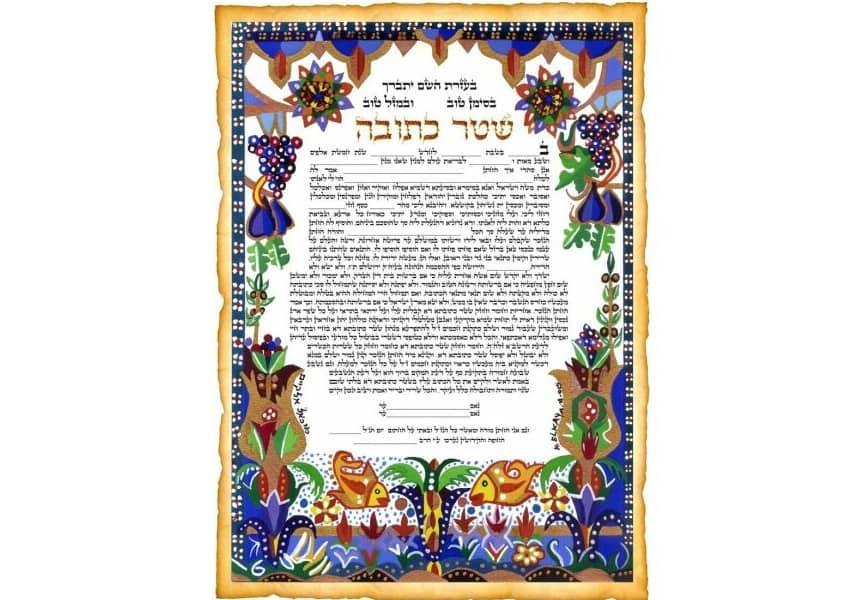
Regarding writing a name in a ketubah, Shu”t Nachalat Shivah, 12 Shetarot, letter 16, writes that ideally one should be precise in a ketubah concerning every matter in which precision is required in a get. This is so that, if Heaven forbid a case should arise in which a man divorces his wife and the exact spelling of his name, her name, or their fathers’ names is unknown, it may be learned from the ketubah.
However, Shu”t Minchat Yitzchak, vol. 7, siman 117, writes that the custom is not in accordance with Nachalat Shivah. This is not the common practice, neither in Bnei Brak nor in Jerusalem. They do not write “d’mitkarei” or “ha-mechuneh” as is done in gittin, except where there are names that must be written because of uncertainty and the like.
Therefore, in practice, it is not customary in a ketubah to add all names with the formulations “d’mitkarei” such-and-such or “ha-mechuneh” such-and-such for foreign-language names. Thus, “d’mitkarei” or “ha-mechuneh” should not be added before the secular name; rather, additional names are generally written in parentheses.
Writing Names in a Ketubah Is More Lenient Than Writing Names in a Get
It is important to note the words of Shu”t Binyan Tzion HaChadashot, siman 172, who explains that one may be more lenient regarding writing names in a ketubah than in a get. Therefore, one who was given a Hebrew name at birth but is only called by a secular name—although in a get both names must be written, as explained in Shulchan Aruch, Even HaEzer 129:16, with the Hebrew name first and the secular name second—in a ketubah, where the family name is written and it is intended only for use by the beit din should collection become necessary, it is sufficient to write only the Hebrew name. Since it appears together with the family name, the person described in the ketubah can be identified.
This is his language there:
Therefore, it appears to me that the essential ruling, as I have already written, is to regard the Hebrew and cradle name as primary, and the name changed to the vernacular as secondary. I have seen and heard that the great authorities practiced this way. In a ketubah, where there is no concern that everyone know who is being referred to, but only the beit din when it comes to collection, it is preferable to write only the cradle name, which was given for matters of sanctity. Any Jewish beit din will be able to collect with such a document, and consequently this name will also remain primary for a get. This is what appears correct to me.
How to Write the Name JULIA — ג’וליא
Regarding the correct manner of writing the name JULIA, the Beit Yosef, Even HaEzer 129:34, writes that all Hebrew names are written with the letter ה at the end, such as “Choma,” the wife of Abaye. However, a name that is not Hebrew is sometimes written with the letter א at the end. This is likewise stated in Nachalat Shivah, Shetarot, siman 12, letter 16.
Therefore, the correct spelling of the name ג’וליא ends with the letter א [ג’וליא], and not with the letter ה [ג’וליה].
Regarding writing it with the letter ג and a geresh above it, this is the Sephardic custom, as written in Shu”t Yabia Omer, vol. 4, Even HaEzer, siman 13, and likewise in Shu”t Ish Matzliach, vol. 3, Mazkeret HaGittin, siman 82.
However, in many Ashkenazic communities outside Israel, the custom is to write דזוליא, combining the letters ד-ז, whose pronunciation corresponds to the English letter J; or דזשוליא, combining the letters ד-ז-ש, whose pronunciation likewise corresponds to it.
This response was translated automatically from Hebrew and has not yet been reviewed by a person. Therefore, it may contain inaccuracies and should not be considered a definitive reference.
This response was translated automatically from Hebrew and has not yet been reviewed by a person. It may therefore contain inaccuracies and should not be considered a definitive reference.