The Success of Soldiers Is Only through Those Who Study Torah
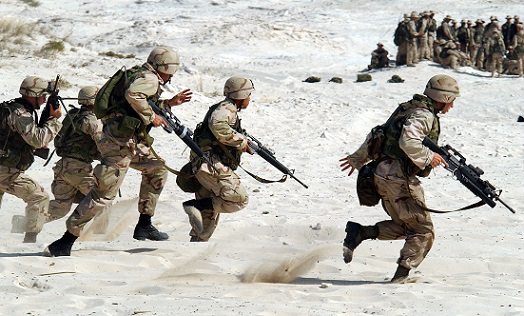
The Gemara in Tractate Makkot 10a states: “Rabbi Yehoshua ben Levi said: What is the meaning of the verse, ‘Our feet stood within your gates, O Jerusalem’ (Psalms 122:2)? What caused our feet to stand firm in battle? The gates of Jerusalem, where they were engaged in Torah study.” That is, the success of those who go out to war is through the merit of those who remain in Jerusalem to engage in Torah study.
Midrash Tanchuma, Parashat Matot, section 4, states concerning the verse, “A thousand from each tribe, a thousand from each tribe” (Numbers 31:4), that from each of the twelve tribes of Israel—each of which had between twenty-four thousand and sixty thousand men of military age—only one thousand men were sent from each tribe to fight. Another thousand from each tribe were appointed to pray throughout the war, while the rest of the tribe studied Torah; thus they were victorious.
Our Sages further said—in Bereishit Rabbah, Parashat Toldot, chapter 65, section 20; Yalkut Shimoni, Toldot, remez 115; and elsewhere—regarding the verse, “The voice is the voice of Yaakov, but the hands are the hands of Esav,” that “when the voice of Yaakov—the Jewish people—is heard in synagogues and batei midrash, the hands are not the hands of Esav”; that is, the nations cannot prevail in war against the Jewish people, as the Midrash explains there at length.
In the holy Zohar (Beshalach 58b, translated into Hebrew according to the Matok MiDevash commentary), Rabbi Chiya explained the verse, “Your right hand, Hashem, is glorious in power”—this refers to the Torah—and thereby, “Your right hand, Hashem, shatters the enemy”; through Torah study, You shatter the enemy. For nothing in the world can break the power of the enemy except when Israel engages in Torah study. As long as Israel engages in Torah, the right hand of the Holy One, blessed be He, is strengthened and the power of the nations is weakened. Therefore the Torah is called strength, as it is written, “Hashem will give strength to His people; Hashem will bless His people with peace”—when Hashem gives Torah to His people, He blesses them with peace, so that our enemies fall before us. But when Israel does not engage in Torah, the left side—that is, the forces of evil—gains strength. This causes the power of the nations to increase; they rule over Israel and decree decrees that cannot be endured. It was solely on account of this that Israel was exiled and dispersed among the nations, etc.
An Additional Reason to Prevent Enlistment: Concern for Spiritual Decline
It should be noted that all the above is a reason to prevent yeshiva students from enlisting even in the unlikely event that it would be possible to establish a unit in which Torah and mitzvot are observed meticulously. Yet it is highly unlikely that such a reality could be maintained. In practice, recruits are exposed to many things from which yeshiva students are shielded, and they also lose their sensitivity to Shabbat observance and many other matters. There is much more to discuss on this subject; indeed, it alone could fill an entire work.
In this connection, it is fitting to quote the pleasant words of Maran Rabbeinu Ovadia Yosef, zt”l:
“…He also goes into the army, and naturally there is no fear of Heaven in that place. Young men who went into the army, when they returned after two and a half or three years, came back ‘marked, speckled, and mottled,’ with nothing remaining of Torah. Etc. Therefore, one must endeavor to maintain one more yeshiva student and one more measure of Torah, etc. The holy yeshivot are our crucible for spiritual preservation, Torah study, and fear of Heaven. Even someone who knows that his son is not especially talented and thinks that he will not become a great Torah scholar should nevertheless send him to yeshiva. Even if he does not become a talmid chacham, at least he will be G-d-fearing.” (Ma’adanei HaMelech, Torah Study section, p. 435)
A Third Reason to Prevent Enlistment
There is also a third reason for instructing people to refrain from enlistment in the army: its decisions are not made according to Torah law, and soldiers’ lives are often endangered because of political and media considerations. Thus, a person who enlists is not merely endangering himself in order to defend the Jewish people; he is also endangering himself needlessly—though certainly also for defense. We likewise heard from Rabbi Chaim Kanievsky, zt”l, that for this reason as well there is no permission to enlist in the army. This claim requires extensive discussion, for which there is presently no time.
Even According to Natural Considerations, the Benefit of Enlisting Yeshiva Students Is Highly Doubtful
Moreover, leading military experts have already determined that enlisting yeshiva students would only burden the army’s budget; it would be preferable to direct those resources toward developing military technology. Military committees have already been established in this connection, and their clear conclusions may be seen in the book Torato Umanuto, p. 41 and onward. This has become especially evident recently: had development of the laser-defense system been at a more advanced stage, the entire war would have looked different. The events of October 7 likewise demonstrate that, with intelligent development of means to detect mass approaches to the border fence, breaches of barriers, and terrorist infiltrations, together with automatic alerts to all relevant centers, everything could have been prevented through natural means. Especially in the age of artificial intelligence, there was no need to rely solely on human observation, which proved deficient. Needless to say, even if the present war created a need for widespread reserve mobilization, that need is ultimately one-time, and cumulatively mobilizing reservists costs the State of Israel far less than permanently maintaining a large-scale army—contrary to the absurd propaganda directed against yeshiva students. Thus, even from a material perspective, enlisting yeshiva students harms Israel’s security; all the more so from a spiritual perspective, for, as stated, the way to protect the Jewish people is to have as many Torah learners as possible. Through them, the Holy One, blessed be He, protects Israel and sends blessing and success through Israel’s soldiers.
In brief, yeshiva students bear a very central part of the burden. Not everyone in the army serves in combat; there is also a need for those who sit safely at computers and the like. Yeshiva students are the unit that protects all of Klal Yisrael through their dedication to the study of the holy Torah. Indeed, it is yeshiva students who enable combat soldiers to return home safely.